If you are from a mechanical engineering background, you might already know about stress and strain. So, what is this Engineering stress / strain and True stress / strain. How are they different and what is their use?
Imagine a material with initial length L0 and intial area of cross-section A0 which is deformed by application of force P. L and A are instantaneous length and area.
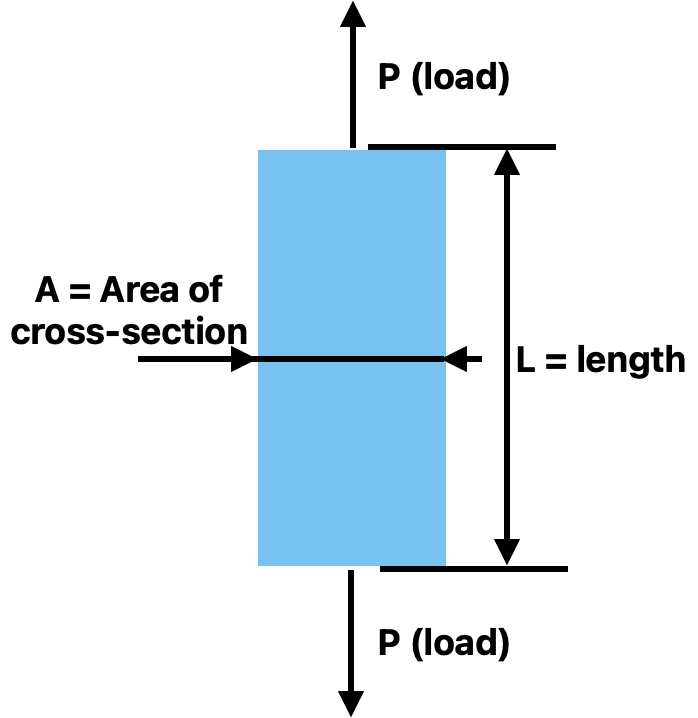
Engineering stress/strain is defined on the basis of original length and cross-section, irrespective of how much the material has deformed –
\(\) $$ Engineering \; stress\;(s) = \frac{P}{A_0} $$ \(\)
\(\) $$ Engineering \; strain\;(e) = \frac{(L-L_0)}{L_0} $$ \(\)
True stress/strain is defined on the basis of instantaneous length and cross-section –
$$True\; stress\; (\sigma) = \frac{P}{A}$$
$$True\; strain\;(\epsilon) = \int_{L}^{L_0}\frac{dL}{L} = \ln\frac{L}{L_0}$$
Shown below is the stress-strain curve of a majority of materials. The curve in blue is Engineering stress – Engineering strain diagram for and curve in green in True stress vs true strain in the plastic region. In elastic region they pretty much coincide, although not necessarily.

While the engineering stress and strain work well for small deformations, they do not represent the behavior of metals accurately for larger deformations (strain > 0.1). This can be understood by following examples –
- As the sample becomes longer, any fixed deformation will cause lower strains. For example, a deformation of 1 cm on a 1 m long sample shall give a strain value of 1 % while the same 1 cm deformation on a 2 m long sample should give a value of 0.5 %. This behavior is not captured by the definition of Engineering strain.
- As the sample’s length changes so does its cross-section. Using only the initial values of area will either overestimate or underestimate the actual stress values.
Hence true stress and true strain are defined, which can be used to accurately describe material behavior. True stress and strain defined based on instantaneous values of length (L) and area of cross-section (A).
The relationship between Engineering strain and true strain is given by following equation –
$$\epsilon = \ln(1+e)$$
The relationship between engineering stress and true stress is given by –
However, these equations are only valid to the point of necking (when one cross-section in the sample starts to reduce more than others). Beyond that the values of true stress and strain shall be calculated by measured values. For comparison, engineering stress vs engineering strain and true stress vs true strain looks like Fig. 3. Note that Engineering stress vs engineering strain curve implies that the metal becomes softer after point 1 (necking), which in reality it does not.